As often happens on cruises, you don’t find your rhythm until the end of the trip. This sentiment is now being realised on board as everyone keeps mentioning how it feels like we have fallen into a routine. Everyone now has their sleeping schedule, is more than familiar with the ship, and knows where they fit into the team. Despite the novel science occurring every day it can sometimes feel difficult to share updates when everyone is so enveloped in their routine.
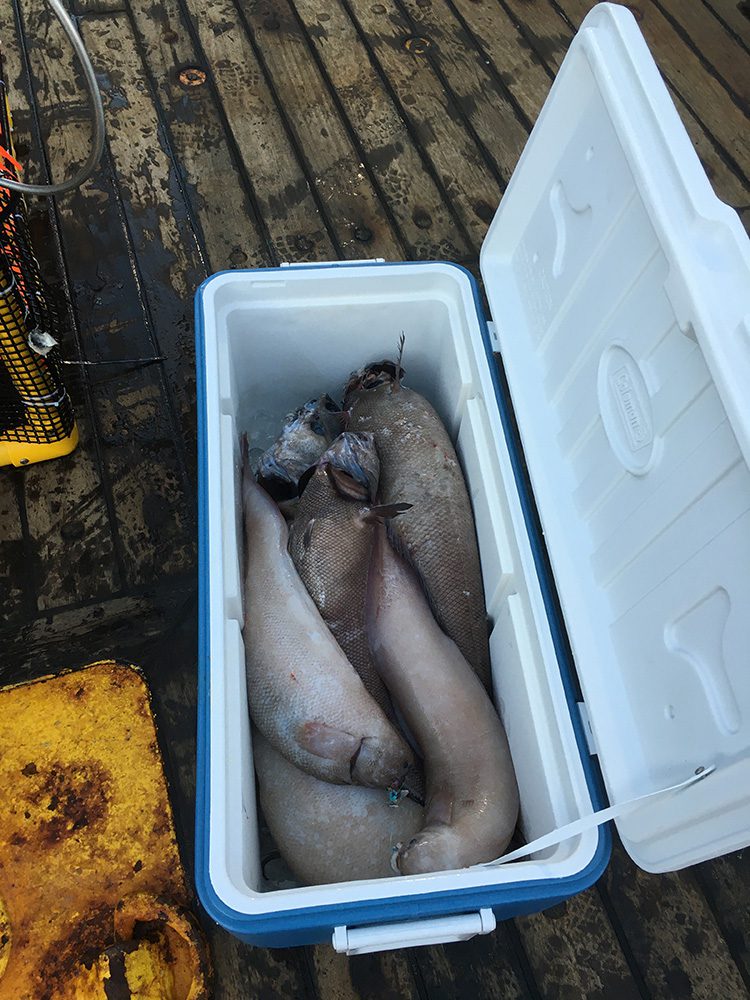
The lander team is always busy and it can be difficult to keep track of which landers are deployed or not. In the latest baited trap deployment, Prof. Andrew Sweetman, Alycia Smith, and Daniëlle De Jonge counted at least 13 fish in the trap and managed to retrieve 10 of them to process (three fell off during lander recovery). They found plenty of amphipods eating away at the captured fish, including some large ones. The trap has since been sent down a third and final time for its last deployment of the cruise. The sixth camera lander deployment has been recovered and the seventh is scheduled to be sent down tomorrow.
So far the team has seen a higher scavenging rate when squid is used as bait compared to fish. This means the fish come to eat the squid faster than they do with the fish. As squid are predicted to become more common under climate change, this observation has interesting implications, which Daniëlle tells me she is still working on untangling! The team are hoping there will be time for 9 deployments in total, with the final one focused on whether or not rat tail fish will scavenge on their own species. Rat tails collected in the previous baited trap have been frozen in order to conduct this experiment. The respirometer lander has completed all its deployments with normal algae, so the next two will focus on degraded algae. This way the team will be able to compare in situ rates of respiration at 4000m to the on board ex situ experiment.

So far we have done 19 CTD casts led by Angela Mosquera and Iván Mouzo. Angela devotes time each day to analyse the data collected. Across the 19 CTDs she found that the physical oceanographic properties are similar, meaning this area of the ocean is homogeneous. As we are not covering that large an area relative to the scale of the ocean basin, this is to be expected. The CTDs are collected with the main aim of being able to better understand the environmental conditions in the areas where ROV dives are happening and eDNA samples are being taken. With the latest CTD, there have been sufficient samples to cover and describe particulate organic carbon (food supply) at Cadamosto Seamount. This hopefully means the end of Bea Vinha and Andrea Gori’s sleepless nights filtering water. Susan Evans is also happy with the spread of water samples, which will allow her to compare the eDNA found in the CTD and ROV samples to the organisms observed by the ROV cameras.
Since the last update we have done two more ROV dives, both on Cadamosto Seamount. The first dive followed a transect close to the first one we completed at the site. The ROV video cameras showed more or less the same organisms to those we saw on the first dive. This meant brittle stars and sea urchins galore! We also saw some Anthomastus soft corals and collected one for Andrea Gori to trial in aquaria. We take the opportunity to sample corals that have not been worked on before in aquaria so we can observe how they respond to the sampling process, and assess whether they could potentially be used in future aquaria experiments. For corals to survive, they need to be hardy enough to be sampled with an ROV and be able to adjust to the new water in the on-board aquaria.
Yesterday we completed a transect along the north east section of Cadamosto. It was an incredible ROV dive with Metallagorgia gardens and high coral and sponge biodiversity. If the weather allows, we have two more ROV dives planned: one at Fogo continental shelf so that we complete the magic number of 3 dives for that area, and one final dive at Cadamosto where we aim to start in the middle of the transect so we can reach the summit, which we have only done once.
Whilst we’re processing all the imagery from these most recent dives, here are some photo highlights from the ROV’s outing on 16 August. All images © ROV Luso / iMirabilis2.
Two nights ago the Autosub6000 returned from her first 24-hour mission at 3000m to a spirited welcome back on board. After being plagued with technical issues, everyone was rooting for the AUV and her hardworking team. We were all happy to see her return to the ship! The sub was welcomed back to a sound from the ship’s horn and Iván Casal playing a song on the Galician gaita. Susan was able to collect 15 eDNA samples with RoCSI during the mission. However, there were unfortunately issues with the Autosub6000’s multibeam system so we didn’t get any bathymetric data. The AUV team have since been working hard to replace the multibeam system, which was overheating. After deconstructing a portion of Autosub6000 to access the multibeam, the spare system has been placed inside and they are now working on getting the sub to communicate with the new system. Once the AUV is ready to go back in the water, she will be able to survey a larger portion of seafloor as her 24-hour mission has proved she can stay on survey lines and fly between volcanic cones. The next AUV mission has multiple aims: to understand the seafloor morphology, collect backscatter data to derive information about sediment and substrata types, and to collect bathymetry data to safely identify a flat location for a photo survey close to the seabed.


Behind the scenes, cruise leaders Cova Orejas, Veerle Huvenne and Andrew Sweetman, along with the help of Andrea Gori, have been hard at work planning all the logistics. The cruise leaders spend time each day discussing the plan and backup plans for the coming days. They are continuously adapting to weather and equipment conditions. Two days ago a last minute decision was made that the ROV could not be deployed due to the weather, and the AUV team was asked to get ready in record time so they could complete a surface test. Part of the planning process is to make sure that each team has enough time to sleep in between operations, as well as process samples and get ready for the next mission. Veerle has been working on designing the AUV missions, following the mission as it is ongoing, watching the track it begins on and then leaving it alone once she is sure it is behaving properly. She is also the science team member most involved in ship multibeam surveys and has been coordinating watches or collecting the data herself. Veerle and Andrea hold the fort during the night and early hours of the morning. One of the two of them is always awake so there is someone in charge should an issue arise in the lab or the bridge needs to contact them for further direction. The times they need to be awake can fluctuate depending on what operations are ongoing. When I last asked Andrea at 22:30 if it was his evening or morning, he told me he did not know… such is life at sea!
What is it like on an ocean-going expedition? Having never been before, I was thinking this myself. I watched land slowly diminish from sight as we left Las Palmas harbour, experiencing a mixture of excitement for the expedition ahead, trepidation at its many unknowns, and a little drop of fear as I realised my month aboard a research vessel had begun. I wouldn’t see land for another four days as we steamed to Cape Verde.
I felt quite a bit of pressure coming on this expedition, as it’s my first opportunity to do “the other half” of my role as an AUV Operations Engineer and my chance to see if I really measure up to the demands of the role. I had questions of course, most of them trivial. Would I get seasick? What would the food be like? Would I get on with the rest of the expedition team? I can happily report I was worried about nothing on all counts.
Before departing, I was excited about what I might see while away and since first sighting Cape Verde I’ve not been disappointed. I’ve seen the ship’s wake sparkling with bioluminescence under the glow of the Milky Way above; huge pods of dolphins dancing in the waves; shoals of flying fish exploding out of the water; squid fishing in the ship’s lights after dark, and some of the most beautiful sunsets I’ve ever witnessed.

It hasn’t all been smooth sailing and nature watching though, as we have had technical issues with the Autosub that have prevented us from completing some missions, which hit morale hard. Recent days have been start-to-finish troubleshooting, testing, fixing, and head-scratching as we chase down gremlins in the sub. It has been a steep learning curve for me but we’ve managed to keep our chins up, get the sub fighting fit again, and as I write she is on a mission at 3500m.
Despite the issues we’ve had, the rest of the expedition have been nothing but supportive, which has helped us through those tough days where progress is slow. There’s a real team spirit on board. Spending so much time with the same small group of people means you get to know everyone quite well. A few weeks ago, everyone was a stranger but now it feels like one big group of friends. We’ve all ended up on a slightly different schedule, however, and there is always somebody up and working. It’s impossible to know what time of day it is for them. It might be dinner for me, but breakfast for somebody else. I’ve given up trying to guess if it’s “Good morning or “Goodnight” at this point!
Downtime is important as well. There’s a gym on board (which I haven’t used nearly as much as I should!), a dartboard, games consoles, and tables for card games. I’ve spent a lot of time, however, on deck looking out over the sea. Sometimes it’s a volcanic island, other times an endless expanse of empty water. Whatever the view, they are always the sort to make you think. I find it quite peaceful.

Those quiet moments are valuable because the ship is constantly noisy, pretty much wherever you go. In my bunk at night, I can hear the rumble of the engine, the whine of the buoyancy compensators, and all the other sounds of the ship. During the day the cranes and winches will be working, and the crew might be carrying out some maintenance, which usually involves power tools. There are very few “quiet” places on board, but by this point I’ve grown accustomed to it. In a way it’s reassuring because it means everything on board is working!
The expedition has been fantastic so far, but I do miss home. There are about 2 weeks left to go, and it has been 5 weeks since I flew out but sometimes it feels like it has been longer than that. Communications home have mainly been through messages and voice recordings since the internet isn’t fast enough to really do live voice or video calls, although there is one satellite phone in the computer lab that we can use to make international calls. I’ve managed to keep in touch with loved ones well enough but I’m excited to actually have a live, face-to-face conversation with my partner Lauren when I get home!
For now, there are more missions to run, more data to process, undoubtedly more issues to fix, and certainly more successes to share. We pick up Autosub after her 24 hour mission this evening to see how she did. Then we’ll do it all over again, crossing our fingers as we watch her dive down and down to the depths of the ocean. I don’t know what we’ll see, but I do know it’s worth looking.

On Sunday afternoon the conditions were just right and we were treated to another day of ROV operations. We returned to Cadamosto Seamount where we had a spectacular dive with the highest density of octocorals and sponges we have seen on the cruise so far! Sponge aggregations, coral gardens and vertical walls colonised with sponges were just some of the incredible images we saw. The dive began at 2000m and we finished our climb up the flank of the seamount at 1735m. It was a challenging dive technically, with the current direction facing the ROV and the steep rocky cliffs at the site. At the start of the dive we saw a fishing line in the water and spent the better part of an hour repositioning ourselves to avoid becoming tangled in it. After a ship manoeuvre, the ROV was able to safely descend and touch bottom where we immediately saw a rock covered with octocorals. Coral abundance and the size of the sponges we saw was impressive, and we also noticed quite a few Brisingiids. So far we have seen the coral Metallagorgia on every dive in Cabo Verde, but they were especially abundant here. We sampled the soft coral Anthomasthus, a corallium-like octocoral, elephant’s ear sponges, and trialled the zooplankton sampler, which unfortunately did not yield much zooplankton. We were working on a rocky bottom throughout the entire dive which meant we did not see as many of the species typical in sediment environments such as holothurians, brittle stars, and sea urchins.

After the dive we collected a CTD at the site. Bea Vinha took water samples to filter for particulate organic carbon (POC). As more biodiversity was seen at this site compared to the first dive at Cadamosto Seamount, Bea will compare the POC values at each location. As POC is often used as a measurement for food quantity, increased POC at the latest dive site could be the driver behind the species distribution. If the POC values are comparable between sites then the hypothesis is that the currents likely make this site suitable for high biodiversity.
In addition to amazing videos from the ROV, the baited camera lander provided some exciting deep-sea pictures this week. On this fourth deployment we used squid as bait, and the team got their first full-length picture of a Synaphobranchid eel. There were also potentially different species of the rat tail fish and cusk eels present. After the fish and eels wiped the lander clean in just 5 hours, a large shrimp (possibly Cerataspis monstrosus) appeared as well. The benthic lander team had an exciting milestone this week as the respirometer recovery on 13 August marked Prof. Andrew Sweetman’s 300th lander deployment of his seagoing career since he began his count in 2015.
On Monday, some of the science team got a tour of the engine room. It was exciting to see a new part of the ship and journey down to the bottom of the staircase – we usually limit our activity to the main three floors. Tomas from the ship’s crew explained the forward and aft thruster, ballast water system, compressor systems for all the fridges and freezers on board, main propulsions, and generators. It was fascinating to hear about how the ship sterilises its ballast water with UV light and a filtration system to help prevent the spread of invasive species as the ship travels around the ocean. We were also shown a map of all the tanks on board which can hold diesel oil, ballast water, dirty oil, or fresh water for domestic use. Most of the tanks on board are diesel, which once allowed the ship to go all the way from the Spanish Antarctic station to Las Palmas without refuelling! The crew who work in the engine room are also largely responsible for emergency procedures and can initiate firefighting methods using CO2 and steer the ship should the Bridge lose control. After using the on-board electricity and water supply for nearly a month without giving it much thought, it was a great to see all the work that goes into providing these services and keeping the ship running.


Our Monday ended with an Autosub6000 surface test set against the incredible backdrop of Brava island. Just before launching we watched as a school of cetaceans swam and played near the vessel. We then enjoyed cake with dinner to celebrate the second on-board birthday: Antonio! He told me having a birthday at sea makes the day special by default. He also said that the day was different and fun with a highlight being the WhatsApp video call home courtesy of Roger extending some Wi-Fi privileges to the birthday boy!


After high winds at Cadamosto Seamount caused us to head for the shelter of Fogo Island, we changed the plan of our third dive and revisited Fogo’s continental shelf. Our first dive there consisted of mixed sediment and rocky views, but this second dive brought us down to an area dominated with large geological structures.
Almost immediately upon starting the dive transect, we saw that the octocoral Acanella sp. was common in the area. We took three samples for Bea Vinha’s trophic ecology work. On previous dives we’d been surprised at the apparent lack of sponges in the region and hadn’t yet taken a sponge sample. However, during this dive we began to see white glass sponges of various sizes and took advantage of their abundance to take samples. One of the sponges we collected was the Venus flower basket sponge. This sponge associates with a mated pair of shrimp who spend their entire life inside the sponge once they grow too large to escape the small holes.


Organism associations or symbionts ended up being the theme of the dive as we also collected two other symbionts, one we expected and another which took us by surprise. We sampled an octocoral from the family Pleuxaridae for taxonomic work to identify the species. This coral had 4 symbiotic brittle stars living on it, which is a common occurrence in the cold-water coral world. However, each of the three Acanella sp. samples also had one polychaete, all apparently of the same species. Despite not intending to sample the polychaetes, once we discovered them, we did some opportunistic sampling and preserved them for stable isotope and fatty acid analyses along with all the intentional samples.
This was a special dive for me as it was the first dive I was able to spend in the ROV cabin. Like most members of the science team, I watched the previous dives on this cruise from the scientific laboratory, either observing the imagery and helping spot animals or annotating on the ocean floor observation protocol (OFOP) software. For this dive I took on a new role of taking pictures on the ROV’s scientific camera for the majority of the dive. In addition to the 4K camera we use during ROV dives and the other cameras used by the pilots to monitor Luso during the dive, there is also a scientific camera attached. This camera has a wider frame of view than the 4K and occasionally during the dive I was asked to aim my camera towards one of the ROV manipulator arms to check everything looked alright. The scientific camera is operated with a joystick remote to move the field of view in combination with a computer to focus, zoom, and take the pictures. If a scientist is not able to actively take pictures then the camera will automatically take one picture during the dive every minute. I enjoyed moving the camera around and getting a sneak peek of what Luso might see next. I was also able to turn the angle from side to side to view organisms and geological features just outside of Luso’s view. Being in the cabin was a great experience as I got to see how the ROV team worked. Before this experience I did not know that the ROV co-pilot speaks to the bridge to confirm ship movements and location. It was also exciting to see how the co-pilot uses the mini manipulator arm in the control cabin to make Luso’s arm move underwater. The ROV pilots are truly a great team and it is really impressive to watch how they work and communicate together.
While most of my scientific remit on board relates to the ROV operations, I also make sure to catch up with the other teams on board. Autosub6000 had its first successful mission on Thursday and was deployed again on Sunday. On the first dive, Susan Evans was able to obtain her first eDNA samples using RoCSI and collected 200mL samples in all 24 filters. After the AUV is recovered, these samples are stored in the -80˚C freezer to be analysed back on shore. Between each mission the tubes in RoCSI must be cleaned to prepare for the next dive. Susan was excited that a CTD was taken at the same location as the first dive – this means she can compare the eDNA samples collected via both methods. On the latest Autosub6000 mission Susan was able to get 1.5L samples with RoCSI at 3000m water depth. The next Autosub6000 missions aim to combine RoCSI sampling with high resolution multibeam bathymetry and photography.
The team from the Lyell Centre, Heriot-Watt University finished their week-long on board sediment incubation experiments on Friday with exciting initial results. This experiment, run by Daniëlle De Jonge, Alycia Smith, and Prof. Andrew Sweetman had two single-stressor treatments (reduced particulate organic carbon (POC) influx quality, and increased temperature) as well as one combined multiple stressor treatment. From respiration measurements they found reduced POC flux quality slightly lowered respiration rates while the 2˚C temperature rise increased respiration rates. In the dual stressor treatment it appeared the two stressors interacted as the respiration rate increase was not as high as in the temperature increase alone. Increased temperature has a significant impact on respiration rates, nearly doubling the measurements found in the control treatment. These findings support the hypothesis that as our ocean warms the sediments will become a less successful carbon sink. As POC sinks to the seafloor, some is eaten and respired and the rest is buried. Increased respiration rates on the seafloor means decreased POC burial, suggesting decreased carbon storage rates in our future ocean. These results might also impact what we know about sediment community oxygen consumption (SCOC). When seafloor areas are compared, higher SCOC generally means the area is more biologically active. However, in this experiment they found increased temperature also increased SCOC. The hypothesis behind why this change occurred is that respiration increased just to keep regular maintenance going. With more energy going to supporting normal functions, this could mean less energy for other functions such as reproduction. In this case increased respiration rates does not mean there is more secondary production, but that more energy is needed just to sustain the same level of biomass. This hypothesis will be explored in further detail through the stable isotope samples taken which will be analysed on shore. You can listen to Alycia Smith explain this experiment in the video below.


In the run-up to the weekend, we had a couple of days with high winds which prevented us from deploying the ROV and Autosub6000. To fill this time we took CTD samples and did some multibeam bathymetry mapping. Increased CTD operations means that there is a lot of water filtering happening on board, led by Susan Evans, Bea Vinha, and Andrea Gori. At one point water filtration for POC, fatty acid, and stable isotope analysis had been going continuously for over 24 hours! Susan filters water for eDNA and Bea and Andrea filter water for trophic ecology and bentho-pelagic coupling studies.
The multibeam mapping can happen at any time of the day, which meant that I, along with some others, moved to a late shift. I spent two nights on a multibeam bathymetry watch in the late night/early hours of the morning. We have been collecting bathymetry in the area to fill in some gaps in existing bathymetric maps to better understand the area and more accurately choose locations for AUV and ROV missions. The addition of these late-night multibeam shifts means I sleep until lunchtime, and whilst I have adjusted to the new schedule just fine (with a little help from the on board coffee machine) I can’t say that bean soup when I wake up at lunchtime hits the spot in the same way cereal does for the first meal of the day.
While all the exciting science has kept us busy, there is still some time for relaxing. One activity we do on board is decorate styrofoam cups and models. Murray Roberts and I brought some styrofoam and pens on board for everyone to use. People draw on the cups and models as they please and then hand them off to one of the ROV or CTD technicians. They are then sent down on the equipment and crushed under pressure. When they return to the ship they are miniatures! Drawing on these cups are a fun evening activity.
When we are lucky we also get treated to live music! A few nights ago the UTM technicians Roger Mocholi Segura, Iván Casal and Mario Sanchez treated the ship to an impromptu concert on drums and guitar. It was great to listen to their music as we mapped off of Fogo and was absolutely a highlight of the week.
We are looking forward more scheduled AutoSub6000 and ROV dives coming up and can’t wait to see more images of the seafloor!


Shipboard entertainment, courtesy of Roger, Ivan and Mario. Video by Murray Roberts / UEDIN / iMirabilis2
Preventative maintenance is paramount in the fiercely corrosive environment at sea. No time is wasted once the Autosub6000 has landed back on deck following a deployment. Moving parts are stripped from the vehicle, fully flushed and cleaned, before being packed with environmentally developed grease to preserve components during forthcoming deployments.
Another significant part of the Mechanical Engineer role includes Launch and Recovery System (LARS) Pilot. The deployment and retrieval of the AUV from the ocean is a particularly precarious and risky part of our operations, with the vehicle potentially being subject to forces of up to 6G (6 times that of gravity), and requires the coordination and manual skill of the Captain, crew, and LARS Pilot:
Whilst the Sarmiento de Gamboa can operate on auto-heading and doppler-positioning to hold steady in the water, to do so requires intermittent autonomous use of tunnel thrusters using PID control (a bit like cruise control in a car). These thrusters suddenly firing up can cause eddies along with high and low pressure zones at the side of the vessel, potentially sucking the submarine under the ship and into its exposed propellers, inflicting terminal damage. Controlling the ship manually lowers this risk where control can be more subtly applied.
The ship’s crew are incredibly well rehearsed in overboard operations aboard research vessels. They grapnel the Autosub6000 retrieving recovery lines (i.e., using a pole with a hook on the end to latch onto the wires), attach to the LARS, and hand the control over to the LARS Pilot.
During these operations, the LARS Pilot will carefully observe the swell of the ocean as Autosub6000 patiently awaits recovery. The hydro-dynamicity of Autosub6000 will cause it to head into the swell, and the LARS Pilot needs to identify optimum moments to recover… fuelled by adrenalin and the temporary ability to slow down time!
Once the LARS Pilot has control, Autosub6000 is carefully guided towards the ship, paying close attention to all conditions. Too much exertion on either line can turn the heading of Autosub6000, which, assisted by swell, can send it careering towards the side of the ship. A harsh blow to the ship’s hull can result in significant damage to Autosub6000 and its science payload, causing much undesired system downtime for repairs.
Once Autosub6000 is directly underneath the LARS carriage, it’s the moment to hoist from the water. But, a swell washing over it at this point can lift Autosub6000 faster than the winches can run, creating slack line. As the wave passes and the seawater level drops away, it’s like dropping a 3000kg mass onto a dynamically moving and accelerating floor, with 1400kg (the flooded volume mass) that doesn’t want to be arrested.
Get it right, and it’s as though the ocean gently passes the Autosub6000 back to the ship. Get it wrong, and Autosub6000 can be violently thrown around. It’s a matter of intuition, experience, and clear communication between all parties concerned that governs the safe recovery of Autosub6000.
Millions of pounds have been invested into the Autosub project. Years of planning have gone into the expedition. And here we are, live at sea, with just a handful of opportunities to get everything right.
But it’s the acquired data where the value of Autosub6000 truly lies. It’s this data that can give today’s scientists insight into the health of our ocean, and this data in turn can educate the generation of tomorrow, that we might be able to manage the ocean sustainably and preserve one of the planet’s most precious resources.
So, no pressure then…


Today is day number 12 on board, and I still see it as a miracle – the fact of being here, looking with my eyes and touching with my hands iMirabilis2. The expedition became real! Why did I wonder so much?
In fact back in spring 2018, iMirabilis started to be shaped, and at that time it was clear that if our project was considered to be of interest and earned us shiptime on Sarmiento de Gamboa, the expedition would take place. The appearance of COVID-19 dramatically changed our lives; even being European and living in first-world countries, many of us have been experiencing the dreadful consequences of the pandemic, in some cases even losing family members and friends. I am fortunate that I did not experience personally dramatic consequences of COVID-19, but in my professional life I did. iMirabilis – the original expedition, planned for Cabo Verde-Namibia-South Africa – vanished in spring 2020, and there were no clear indications that the expedition could happen in 2021. Finally, in November 2020, good news arrived and shiptime for the expedition was allocated for August 2021 but in a much reduced shape: the COVID-19 situation required us to avoid port calls anywhere but Spanish harbours, so the dream to explore Walvis Ridge and several locations off Cape Town became impossible.
Like the phoenix, a new period started for the expedition, re-named as iMirabilis2: the spirit of Weltwischia mirabilis was still there, therefore we kept the name….but as the new main target of the expedition became Macaronesia, a Drago tree was added to our expedition logo.
Since the end of 2020 much of my time has been dedicated to preparing and organising this challenging cruise as best I can – challenging not only due to the complexity of having new technology and large equipment (landers, ROV, Autosub6000), but also due to the new rules for everything… indeed COVID-19 became the real expedition leader.
I could write many pages about how the planning happened and how we dealt with this new situation but I prefer to summarise it in a few take-home messages I learned from coronavirus:
Indeed I believe that without the continuous support received from the iAtlantic community and UTM, the expedition would not have became real, and this spirit is very present on board the ship.
At the end, I believe we all know that to be on board Sarmiento de Gamboa, moving freely (after 10 days of strict quarantine and PCR tests) and making real the scientific ideas we generated almost three years ago, is a small miracle. I never thought that the name of the species I choose to name the cruise – mirabilis – would be so appropriate in the end!


Monday morning started off with recovering the first deployment of the baited trap along with the second baited camera lander. There was quite an exciting moment as a shark was attracted to the fish in the trap as we waited to bring the lander on board. Alycia Smith and Daniëlle De Jonge took pictures of the fish and amphiopods which fell prey to the trap before measuring and dissecting the samples. Five rat tail fish, 4 cusk eels and hundreds of amphiopods were caught in total and three of the samples were heavily damaged as amphiopods or the shark had taken chunks out of them before we were able to recover the lander. Stable isotope and ecotoxicological samples were taken, with a focus on determining the baseline levels of metal concentrations in the organisms. Science team and crew members alike came down to visit the lab and ogle at the deep-sea fish.


With camera lander images now available from both bait types, the team was able to take a first look at comparing the pictures. Andrew Sweetman explained that it seems there are different species compositions which are attracted to the squid and the mackerel, which could have implications on scavenger composition in the region under climate change as the dominant food source is predicted to shift towards squid. The four images below are taken by the lander, all courtesy Prof. Andrew Sweetman / Lyell Centre – Heriot-Watt University / iMirabilis2
On Monday evening we had our second ROV dive of Leg 1 at Cadamosto Seamount. After completing the bathymetric mapping of the area, the expedition leaders created different transects up the slope of the seamount, all meeting in the middle at the summit for ROV dive planning. We started the dive at the 2000 m contour and the ROV pilots skilfully navigated up the transect, following the path to the top of the seamount.
During an ROV dive there is a trade-off between sampling and completing the transect. If you stop to sample and zoom-in on every interesting rock and organism then the transect will not be completed. Alternatively, you can speed up the transect and miss sampling opportunities if zonation in the types of animals present in each area occurs. We were fortunate to have an incredibly successful dive on both fronts as sampling was made in key areas and we stayed on schedule to follow the transect to the peak. We sampled brittle stars and sea urchins at the start of the dive, which were representative of the areas. When we first touched bottom we saw large volcanic basaltic rocks with thousands of brittle stars dominating the area. As the area briefly changed on our ascent, a sandy area opened up where a field with hundreds of white sea urchins was visible. Bea Vinha will use these samples in her PhD thesis for stable isotope and fatty acid analyses to understand the trophic ecology of the area. The ROV science team on board consists of biologists and ecologists as the mission of these dives has a biological focus. However, we were all impressed with the geological features in the area. The Cadamosto seamount is one of the most seismically active areas in Cabo Verde. There have been recent volcanotectonic activity at the seamount, which could one day form a new island in Cabo Verde. The large cooled lava flows were impressive to behold at the seamount as we saw different structures across depths.


As we moved on from the brittle star and sea urchin dominated areas, we began seeing more corals, specifically the Scleractinian coral Enallopsammia. After observing that the coral was prevalent in the area, Andrea Gori made the call to sample it as a potential species for the on board aquaria experiments. The ROV team tried different strategies in sampling the coral, both using the manipulator arm to place it into the bio box as well as using the suction sampler to break off smaller fragments and store them in the suction containers. One benefit of using the suction chambers is that they are better sealed than the bioboxes. This is advantageous during cold-water coral sampling as the temperature at the seafloor is around 5 degrees, while the surface water is over 20 degrees. Keeping the corals in the suction containers ensures the corals are not exposed to extreme heat shock upon retrieval. Both sampling methods were used on this dive to decide which is the best sampling technique for future dives. We also sampled some dead coral for geochemical analyses for onshore partners to reconstruct multidecadal coral growth changes. Bea took some small pieces off of the sampled corals for stable isotope and fatty acid analyses.
Soon after corals became more common at the seamount we reached the summit. The geology was distinct at the top, with red rocks indicating previous hydrothermal activity instead of the volcanic black rocks describing the area. There were also thousands of little white stick-looking organisms present. As the ROV team is currently troubleshooting the zoom on the camera, we did not get a close look at these organisms but are hypothesizing they could be a type of coral or carnivorous sponge. Luckily we plan to return to the site during a future dive, as we aim to target another transect to categorize the habitat on another side of the seamount. Hopefully then we can get a better look or even a sample to understand what these creatures are!
Once the ROV was recovered, Andrea and Bea retrieved the samples and then processed them in the downstairs laboratory with my help. The samples for stable isotope and fatty acid analyses were stored in the -80 degree freezer. The corals were cut into fragments for the experiment and glued onto mounts before being placed in the on board aquaria tank for recovery. We are monitoring their health and hope to see their polyps come out before starting any work on them. As corals use their polyps to feed, we may try to bribe them to come out with some artemia brine shrimp.
After the ROV was back on deck we took a CTD on top of the seamount to have water samples of the area. Susan Evans filtered water for eDNA while Andrea Gori, Bea Vinha, and myself filtered water for trophic ecology and evidence of bentho-pelagic coupling. The CTD took water samples at four different depths (the bottom, 100 m off the bottom, the oxygen minimum zone, and 50 m) and we sampled three replicates of 1 litre at each depth for Bea’s PhD work.


Yesterday, the benthic lander team from the Lyell Centre, Heriot-Watt University finished monitoring temperature effects within the on board incubation experiment. After injecting isotopically labelled algae into 8 different sediment cores, inorganic carbon and oxygen consumption rates were recorded. In this experiment 4 cores were injected with fresh, high quality algae and 4 with dialysed algae, which means it was grown in an environment to make the algae lower quality. One climate change prediction is that lower surface water productivity will create lower quality food to sink to the seafloor. As this experiment looks at CO2 production and oxygen consumption to quantify seafloor respiration under climate change, the work was done both at the current seafloor temperature of 6.5 degrees as well as the climate change predicted 8.5 degrees. This is a multiple stressor experiment where both the effects of temperature, food quality, and the combined effect of the two drivers is explored.
At dinner time we celebrated ROV technician Miguel Souto’s Birthday with a card signed by the science team, some decorations in the dining room, and a cake courtesy of Juan! Miguel normally spends his birthday with his family but shared that he felt quite happy to be on board with us this year.


Overnight we completed a multicorer sample at 4394 m. We have to congratulate the technicians, Iván Casal and Mario Sanchez, as this was the deepest multicore they’ve ever done! It was a successful sample as well with a layer of foraminifera on top with mud underneath. This sample was taken for partners back on shore to look at the foraminifera.
This morning the third camera trap deployment was retrieved. This lander was sent down with mackerel as the bait. On the first deployment the mackerel returned picked clean, but on this retrieval amphipods were still on the bait eating the remainders of the bait. The one deployment with squid returned completely empty as everything had been eaten.
We are currently on route to our next dive location off of Fogo Island. We planned to complete another dive today at Cadamosto Seamount but high wind in the area has delayed those plans. We are looking forward to the next dive and hope to be able to return to Cadamosto to keep exploring the deep!
Eoin, who is originally from Dublin, Ireland, joins the iMirabilis2 cruise along with his three teammates from the National Oceanography Centre in Southampton to operate the AUV, Autosub6000. I sat down with Eoin to find out some more about him and understand the type of work an AUV Operations Software Engineer does.

Eoin is an AUV Operations Software Engineer in the Marine Autonomous and Robotic Systems group at the National Oceanography Centre, UK. He holds a degree in in Mechatronics, Robotics, and Automation Engineering, and a Masters of Engineering in Electrical and Electronics Engineering.
I’ve worked at NOC for two years. After my Masters I was working as a software engineer but was hoping to find a job in robotics. I saw a job advertised in a robotics newsletter to work at NOC on the AUV development team in a more electronic-based role. I applied for that position and the development team shared my CV with the operations team because they had a software-based role open, which became the job I have today. I actually had my on-site interview on St Patrick’s Day, which is a bank holiday in Ireland, so I didn’t have to ask for time off from my previous job at the time.
I think I became interested in robotics at the start of university. But in primary school I would watch ‘Robot Wars’ and enjoyed playing with LEGO. I’ve just always thought robots are cool. You can make cool, clever systems that are mechanical and intelligent.
My primary focus is the Autosub6000, but I’ve also gotten to do some work on the new system in development where I have helped out and written some of the code. My work changes from season to season, sometimes we run tests in person or are working in the hanger with the sub all day. Other days are spent in the office at my desk where I work the usual 9-5 with some flexibility. Tasks include development documentation, research, carrying out tests or sometimes just holding the motor while someone else works on it. We always have hard hats and steel boots prepared both in our lockers at work and in a kit for travelling.


I do enjoy being at sea. Not everyone who joins the team can get their sea legs, but it was fine for me. I like working on a boat and being so close to your desk in the morning and having the meals prepared for you! I also love the fantastic views and adventure you get where you can have morning coffees with ocean sunrises and get to hear a fun fact about deep-sea critters. I really get excited about the work we do, it’s very valuable and interesting – definitely the type of work you feed good about. This is my second expedition; the first one was just three months after starting so I felt a bit confused and scared but also excited. It was definitely a quick start after joining the team but I was happy to help out. This cruise I felt much more prepared for.
I feel silly giving advice, especially because there are lots of different ways of doing this job. I think my best advice to give to someone starting off at university and wanting to get into any field is to go niche in the area of work you want to do, but go wide in the geographic areas you are willing to work in and be ready to go travelling! It was a really big move for me to go from Ireland to England, but I’m happy I did it.
I really enjoy going to sea, being on the ship, and getting to go through the work and see results after solving problems under pressure at sea. I look forward to finding out when our next mission will be and hearing the brief to know what will be loaded out or prepped. I also like the teamwork aspect of this job. The Autosub6000 is a complicated system where software feeds into electronics which feeds into mechanics, so it is very multidisciplinary and interconnected. When the sub goes into the tank for testing, everyone is there. When you are at sea and the Autosub is being deployed, it’s all hands on deck. It’s a really great team to work for and everyone stays positive and calm even when things don’t go to plan.


After a stormy day yesterday with rain, thunder and lightning, this morning we woke up to bright blue skies and a lovely view of Brava Island. The tropical blue sea is calm as the ship stays still to complete some sampling. Earlier today we sent down the box corer to see if there was sediment on the seafloor. Once we confirmed the ship was stationed over a target area with sediment, the multicorer was sent down to take the sediment samples. When the multicorer returns to deck, the top 1 cm of each multicore sample will be preserved for foraminifera analyses. This work, led by David Thornalley at University College London and Irene Perez at Instituto Español de Oceanografia, will use benthic foraminifera distribution across a depth gradient to explore decadal-millennial changes in ocean ecosystems.


Images from the baited camera trap which was retrieved a few days ago, were shared around the ship today and we got to view the incredible pictures of cusp eels, rat fish and other scavenger fish who were attracted to the mackerel. Yesterday the trap was re-deployed with squid as bait to compare the types of scavengers attracted to each bait type. As climate change is predicted to favour squid under future environmental conditions, these studies help explore how ecosystem functioning may change if squid become the main food source for scavenging organisms. One interesting find from the first deployment was the lack of amphipods, which are often common during these deployments, but in this case only a few were seen.


Above and below: Images from the baited camera lander. All images © Andrew Sweetman / Lyell Centre-Heriot Watt University / iMirabilis2


Last night the resiprometer was recovered and successfully brought back on board (see video, left, courtesy of Veerle Huvenne). The samples obtained from the deployment were preserved in formalin. This afternoon, Daniëlle De Jonge and Alycia Smith sieved through the sediment collected to look for foraminifera. After hard work sieving in the hot hanger, their hard efforts were rewarded as plenty of foraminiefera were visible under the microscope. Prof. Andrew Sweetman spent the morning doing winkler titrations to measure the respiration in the samples collected from the lander. From the processing he found the area we are in is very productive. The third lander, the baited trap, is loaded with mackerel and is still on the seafloor, which we will recover tomorrow along with the baited camera lander. Once this lander is recovered we will have our first deep sea fish samples on board.


The AUV team is hard at work ensuring the Launch and Recovery System (LARS) is fully operable for the next dive. On the upcoming mission, the AUV will be sent to collect high resolution multibeam data. Once the target area is surveyed and its mild topography confirmed, the AUV can be sent on a photographic mission. Photos are taken 3 meters off of the seafloor so there cannot be any sudden changes in topography that could trigger the Autosub6000’s auto collision sensor to trigger. Once the mapping and subsequent photographic mission are complete, the scientific AUV team on board can start processing the photographs.
The ROV team is hard at work preparing for our next dive. Luckily they had some time to share the images from the first dive with me. So please enjoy some image highlights from the island of Fogo’s continental shelf! All images below © ROV Luso / iMirabilis2
Last night two of the benthic landers were successfully deployed! In addition to the respirometer, the baited camera lander was sent down to get images of scavengers on the seafloor. Andrew Sweetman, Daniëlle De Jonge, and Alyica Smith attached mackerel to the lander to be used to attract the scavengers. After the fish were secured, everyone crowded out on deck to watch the landers be placed into the water. The Royal Banner of the Royal Arms of Scotland can be seen waving proudly atop each lander.


Early this morning it was ROV Luso’s time to shine as we made the final pre-dive preparations for the first dive of Leg 1. One new addition to the ROV that the team engineered is a zooplankton trap. Zooplankton can be sampled via the slurp tube (like a vacuum cleaner nozzle) and sent into a chamber fitted with a netting to capture zooplankton, which will be filtered through the chamber during a dive.
Around 8:30 this morning the ROV went into the water and began making its descent to 2100 metres depth at the island of Fogo’s continental shelf. We hit bottom in a sediment-covered area and began making our way up the slope. ROV dives often begin lower down on a topographic feature and climb upwards for the best view of what is ahead. If you move down the slope with an ROV you will not have as good visuals as the camera is angled to look forwards and up, not down an incline.
Everyone gathered round the monitors in the science lab to watch the ROV dive – it is certainly the most exciting entertainment on the ship. The ROV operations lasted 12 hours in total as the ROV team took turns doing 2-hour shifts across different stations. The stations include: ROV Pilot, ROV Co-Pilot, ROV Operations Support, Winch Operator and Standby. The Winch Operator and Standby positions are located on the deck whilst the other three positions are in the control room. Once the dive finished and the ROV was brought on deck, science team members were able to go on deck and grab their samples.


Despite being in a sediment-dominated area, we saw some corals during the dive which Andrea Gori made the call to sample. It was a priority for him to retrieve these corals from the ROV as soon as possible as they are living animals he hopes to keep alive on board. If these corals acclimatize to the aquarium on the ship, they will be used in feeding experiments. Susan Evans took her water sample and sediment off of the ROV to be processed for eDNA samples.
Tomorrow the Autosub6000 will be deployed on its first mission, lasting around 24 hours. Once the Autosub6000 is safely moving along the seafloor, the ROV may be sent down for its second dive. I hope to also have some images from today’s dive to share soon!
As the scientific team continue their work on board, you can tour the Sarmiento de Gamboa with the iAtlantic Fellows!
© 2024 iAtlantic. All rights reserved.
This project received funding from the European Union’s Horizon 2020 research and innovation programme under grant agreement No 818123 (iAtlantic). This output reflects only the author’s view and the European Union cannot be held responsible for any use that may be made of the information contained therein.